

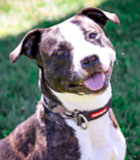
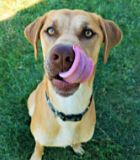
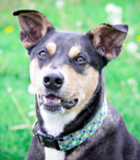
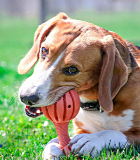




Bismarck
Status: Adoptable | Adoption Survey
Date of Birth: September 14, 2018
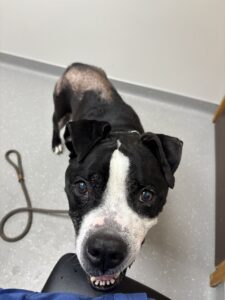
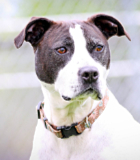
Meet Bismarck
Originally a stray, Bismarck found sanctuary at Mackenzie’s Animal Sanctuary in September 2020. Despite his rough start, this resilient pup has shown incredible spirit and determination in the face of adversity.
When Bismarck first arrived, it was clear that he had untreated allergies that had resulted in patches of hair loss on his backside. His allergies also caused recurring aural hematomas (blood blisters) on his ears. Unfortunately, the severity of his skin infections caused permanent damage to some of his hair follicles, meaning he may never regrow the fur on his neck, rump, or tail.
As if his skin conditions weren’t enough, Bismarck also battles chronic enteropathy, a group of complex gastrointestinal disorders that can cause stomach irritation and diarrhea. He has mild crepitus (joint changes associated with arthritis) in his elbows and pulpitis, an inflammation of the soft inner tissue of his teeth.
Thanks to a special veterinary-prescribed diet and medications, many of Bismarck’s ongoing conditions have been well-managed, allowing him to remain playful and full of spunk! He’s a lively, intelligent boy who seizes every moment with enthusiasm. Whether he’s engaging in an enthusiastic game of tug-of-war or curling up for cozy snuggles, Bismarck embraces life to the fullest, regardless of his medical challenges.
But as we’ve learned over the years, Bismarck’s medical journey doesn’t always follow a predictable path!
February 2026 – Unexplained Fever and Heart Concerns
In February, Bismarck required additional veterinary attention after developing a high fever. His temperature, which had been mildly elevated throughout the day, eventually climbed to 104.3 degrees. Thankfully, despite the fever, he was still feeling well enough to eat some dinner and remained relatively comfortable.
The veterinary team started him on antibiotics and kept him overnight for monitoring. By the following morning, Bismarck was already showing improvement! His fever had resolved, his appetite was returning, and he was noticeably more energetic.
However, there were some other concerns that continued to keep our medical team watching closely. Bismarck had been experiencing occasional abnormal heart rhythms, known as ventricular premature contractions (VPCs). These are extra heartbeats that originate in the lower chambers of the heart and can cause an irregular rhythm. While his heart monitor showed improvement, the abnormal beats occasionally returned.
Although his chest X-rays showed no significant changes and the veterinary team felt he was stable enough to return to Mackenzie’s, the underlying cause of his abnormal heart rhythm remained unknown. Further evaluation with a veterinary cardiologist and an echocardiogram was recommended to get a better understanding of his heart health.
Unfortunately, February wasn’t the end of Bismarck’s medical adventures.
Later that month, Bismarck was transferred to Animal Emergency Hospital (AEH) in Plainfield after developing low blood pressure (hypotension), experiencing two days of vomiting and regurgitation, and becoming lethargic.
The veterinary team decided to keep him overnight for additional monitoring and testing. They performed specialized ultrasounds to check for abnormal fluid accumulation in his chest and abdomen, along with an ECG to evaluate his heart rhythm. He also received IV fluids to help stabilize his blood pressure.
Thankfully, the following morning brought some encouraging news! Bismarck was much perkier, his vital signs were improving, and his blood pressure had returned to normal. The ultrasounds showed no obvious abnormal fluid accumulation, and the heart monitor detected only a very rare VPC.
The veterinary team was hopeful that he could return home that day. One small but important detail? They needed to make sure he was eating before discharge, and AEH didn’t have his special food available. A big THANK YOU to April for making the trip out to bring Bismarck his food! Sometimes, even the smallest things make a big difference in helping our dogs get back on their feet.
May 2026 – A Rather Unusual Emergency!
Just when we thought Bismarck had given us enough medical excitement, he decided to surprise us with something a little different!
During a walk and car ride with a volunteer, Bismarck became extremely overstimulated and hyperaroused. Unfortunately, this resulted in a condition called paraphimosis, which occurs when a male dog’s penis becomes exposed and cannot retract back into its protective sheath.
Now, we know this might not be the kind of medical information you expected to read on a dog’s sponsor page, but it’s actually an important condition for dog owners and caregivers to understand!
When Bismarck was examined, his penis was severely swollen, dark maroon in color, and had started dripping blood. Our medical team immediately went to work.
First, a cool, damp paper towel was held around the swollen tissue for approximately five minutes to help reduce the swelling. Once the swelling decreased, a mixture of white sugar and lubricant was applied, allowing his penis to be gently guided back into its protective sheath.
Why sugar? And why lubricant?
It might sound strange, but there’s a medical reason behind this treatment! Granulated sugar creates an osmotic effect, meaning it helps draw excess fluid out of swollen tissue. As the swelling decreases, the tissue becomes smaller and easier to reposition. Lubricant then helps reduce friction so the tissue can gently slide back into the sheath without causing additional trauma.
This is a recognized veterinary technique, not an attempt to hurt or punish the dog. The goal is to reduce swelling and protect delicate tissue.
Once Bismarck’s penis was safely back where it belonged, he needed some serious downtime! He was extremely overstimulated, so we moved him into a quiet, darkened space with his crate covered to help him decompress. Sometimes the best medicine is simply a little peace and quiet.
It’s also important to understand that this condition can become a serious emergency. When the penis remains exposed for too long, the tissue can dry out, become increasingly swollen, lose circulation, and eventually develop necrosis, meaning the tissue begins to die. Prompt veterinary attention is essential if the tissue cannot be returned to the sheath.
Thankfully, Bismarck responded to treatment!
May 2026 – Another Trip to AEH
Unfortunately, Bismarck’s unusual episode required additional veterinary attention. He was taken to AEH for monitoring and treatment, where the veterinary team administered a sedative injection to help him relax.
The good news? The treatment did the trick!
His penis remained safely inside its sheath, he was urinating normally, and he was resting comfortably. By the following day, the veterinary team felt he was stable enough to return to Mackenzie’s.
However, our medical team still had some questions. Given Bismarck’s history of abnormal heart rhythms and other medical concerns, we wondered whether his cardiac disease could be contributing to some of these unusual episodes.
After discussing his condition with the veterinary team, we recommended moving forward with a cardiac consultation to get a better understanding of his heart health and determine whether there could be a connection.
Because Bismarck’s health involves more than just treating the symptoms we can see, getting answers about what might be happening internally is an important part of making sure he receives the care he needs.
Bismarck’s Care Continues
Bismarck has certainly had his share of unexpected medical adventures. From managing chronic skin and gastrointestinal conditions to overnight hospital stays, cardiac monitoring, and specialized treatments for an unusual emergency, he’s reminded us just how important it is to have access to veterinary care when our dogs need it most.
While some of Bismarck’s conditions are well-managed with his prescription diet and medications, his medical needs are ongoing. His care requires continued monitoring, veterinary attention, and sometimes unexpected trips to the emergency hospital.
At Mackenzie’s, we never want a dog to go without necessary medical attention simply because the situation is unexpected or the expense is significant. Every examination, diagnostic test, medication, hospital stay, and special diet helps us provide the quality of life these dogs deserve.
Your sponsorship plays a crucial role in supporting Bismarck’s ongoing medical needs. By becoming his sponsor, you’re helping ensure he receives the medications, prescription food, veterinary care, and attention necessary to keep him comfortable and happy.
Bismarck may keep us guessing, but one thing is certain: he’s surrounded by people who are committed to making sure he’s cared for every step of the way!
Can’t adopt? Become Bismarck’s sponsor!
To meet Bismarck or learn more about adoption, visit mackenzies.info.
Please sponsor Bismarck today!
|
Use this button if you prefer to make a monthly payment of $25 |
Use this button if you prefer to make a one-time payment of $300 |